Use cases
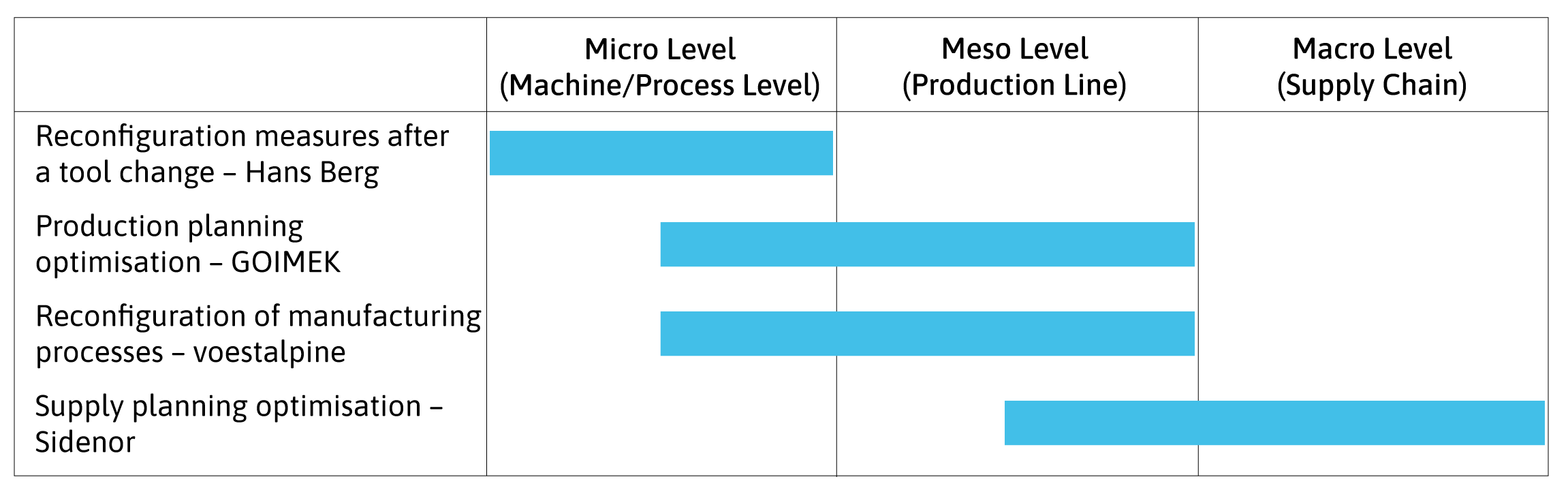
Four industrial pilot cases have been selected for which the project objectives are pertinent. To find out more about the individual use cases, click on the button below the use case description.
Hans Berg GmbH & Co. KG
Challenge: Adjustment measures are necessary when a tool or material has changed, but its duration and success depend on the experience of the employee executing it.
Goal: Reducing the time required to reconfigure the tools, the amount of produced defective components, and the need for the experience required to perform the adjustment tasks.
Sidenor Group
Challenge: Disruptions require reallocating the production, which takes place manually. Decisions taken at network level aren’t connected to the reconfiguration needed at the factory level.
Goal: Reducing the time required for reconfiguration of the production plans for the production network by supporting the user throughout the reconfiguration planning.
GOIMEK
Challenge: The process steps within the production of one part are performed in several working centres. They need to be fixed according to the daily production needs.
Goal: Increasing the efficiency and competitiveness as well as the predictability of production by developing a cross-site production planner, which can be constantly reconfigured.
voestalpine High Performance Metals Digital Solutions GmbH
Challenge: The products vary in size and shape and can only be machined on machinery providing the necessary capabilities, which also vary on other factors such as tools.
Goal: Highly flexible production planning and scheduling, also depending on the current machine state and manufacturing utilities with the opportunity to reconfigure the processes during production.
Pre-pilots
The pre-pilot phase aims to gradually test and improve solutions to reach higher Technology Readiness Levels (TRLs). This is done by first installing and testing the solutions in learning factory environments, which simulate real industrial conditions. These tests use actual process data in controlled settings.
The scenarios are being tested at several locations, including the FlowFactory and TEC-Lab at PTW in Darmstadt, the TEC-Lab at IFT in Vienna, the Forming-Lab at the University of Siegen, IDEKO’s digital grinding hub and the teaching factory at LMS.
In these learning factories, scenarios are developed to simulate production disruptions. The effectiveness of the solutions is tested and refined based on these scenarios. Once the resilience mechanisms prove successful, the solutions are ready to be applied to real industrial cases.
